For Data Centre Managers, few things induce more anxiety than the arrival of an external auditor. Whether it is a client inspection, an insurance review, or a hardware warranty claim, the question is always the same: "Can you prove this environment is safe for the equipment?"
In the financial hubs of Leeds and the public sector centres of the North East, we see many Facilities Managers fall into the "Visual Trap." They look around their server room, see shiny floors and tidy cables, and assume they are compliant.
Unfortunately, in the eyes of the ISO standards, visual cleanliness is irrelevant. The threat to your servers isn't the dust you can see—it's the dust you can't.
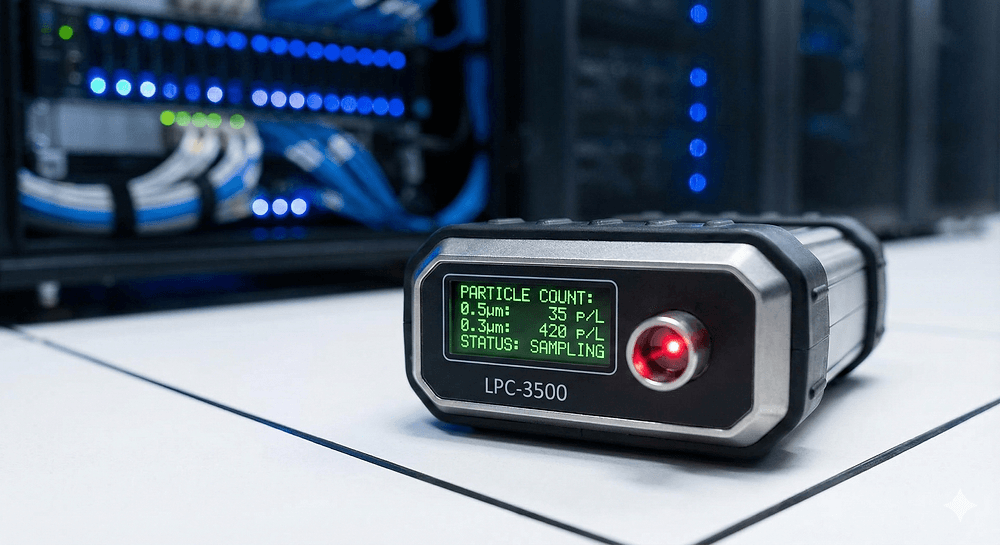
The "Visual Trap": Why Looking Clean Isn't Enough
The human eye can generally see particles down to about 50 microns in size (roughly the width of a human hair). However, the particles that destroy server hardware are significantly smaller—typically between 0.5 and 5.0 microns.
These microscopic particles are small enough to bypass standard intake filters, enter the server chassis, and land on hard drive platters or bridge microscopic circuits on the motherboard.
You could have a room that looks spotless to the naked eye but is actually swimming in invisible contaminants. This is why "janitorial" cleaning fails in data centres. A mop might remove the visible dirt, but it often does nothing for the invisible airborne load.
Understanding ISO 14644-1 Class 8
The global gold standard for data centre hygiene is ISO 14644-1 Class 8. Most hardware manufacturers (including Cisco, Dell EMC, and HP) state in their warranty terms that equipment must be housed in an environment meeting this standard.
But what does "Class 8" actually mean? It is a scientific limit on the number of particles allowed in the air. To pass Class 8, your data hall must have fewer than 3,520,000 particles (at 0.5 microns size) per cubic metre of air. If your facility exceeds this count, you are technically non-compliant. If a server fails and the manufacturer tests the air, they can void your warranty.
The IsoGuard Validation Process: We Don't Guess, We Measure
At IsoGuard, we believe you cannot manage what you do not measure. We don't just "clean" your facility; we scientifically validate it.
Our validation process provides the hard data you need to satisfy any auditor:
1. Laser Particle Counting We utilise calibrated industrial Laser Particle Counters. We sample the air at specific grid points across your facility (as defined by the ISO standard) to measure the exact concentration of airborne particulates.
2. The "Before and After" Test We often test before we clean and after we clean. This proves the efficacy of our work. The idea is to walk into a facility in Teesside or Sheffield that is running at "Class 9" (dirty) levels and bring it back well within the safe "Class 8" zone within a single shift.
3. The Compliance Certificate Once your facility passes, we issue a formal Compliance Certificate and a detailed report. You can frame this on the wall or hand it directly to your auditor. It is your proof that your environment is operating within global safety standards.
Conclusion: Audit-Ready, All Year Round
Compliance shouldn't be a panic-driven event once a year. It should be a state of mind. By scheduling regular technical cleans backed by laser validation, you protect your hardware, preserve your warranties, and ensure that when the auditor knocks, you can open the door with total confidence.
Is your facility actually clean, or just "visually" clean? Contact IsoGuard today to book a Particle Count Test and get the truth about your air quality.