When we conduct site audits across Manchester, Leeds, and the North East, we often see the same pattern. The floor is reasonably clean, the sub-floor is manageable, but the infrastructure above head height has been ignored for years.
In many legacy data centres, especially those retrofitted into older industrial buildings common in our region, the overhead space is a graveyard of dust. Cable trays, fibre runners, suspended ceiling grids, and lighting fixtures act as giant static magnets, silently accumulating thick layers of debris over time.
Facilities managers often ignore this area because it is "out of the airflow path." This is a dangerous misconception. This accumulated dust is a loaded weapon pointing directly at your server racks.
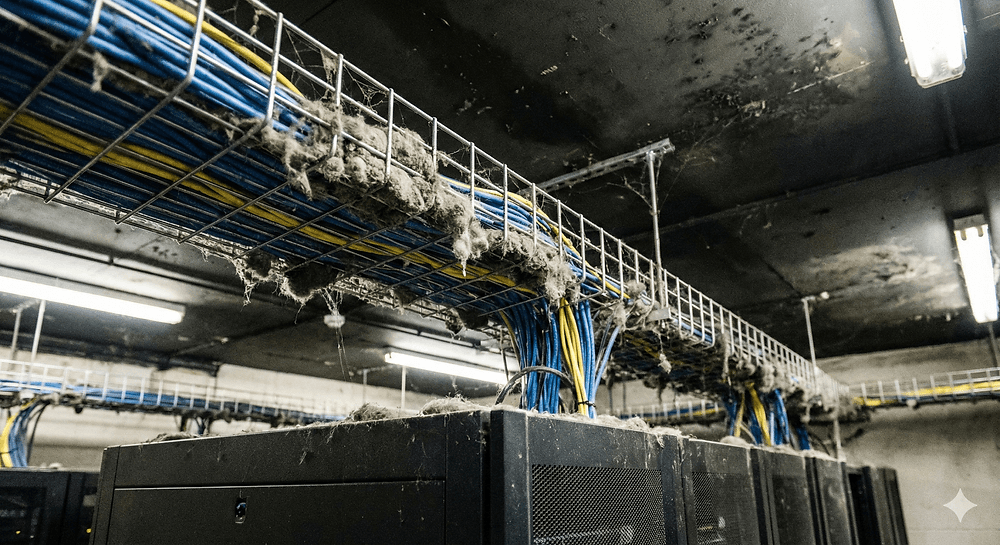
The Phenomenon of "Dust Rain"
Overhead dust doesn't just sit there forever. It accumulates until gravity wins, or until a trigger event occurs.
A "trigger" can be anything:
A door slamming down the corridor.
Maintenance engineers running new cables in the trays overhead.
A sudden ramp-up of high-velocity air conditioning units creating vibration.
Any of these events can dislodge large clumps of heavy, accumulated dust—what we in the industry call "dust bunnies."
When these fall, they don't drift harmlessly to the floor. They fall straight down due to gravity. In a typical hot-aisle/cold-aisle setup, they often land directly on top of server cabinets, bypass intakes, or open network switches.
We have seen instances where a single "dust rain" event has instantaneously clogged the top intake fans of a rack, causing immediate thermal alarms and hardware throttling. It bypasses all your careful floor-level filtration and dumps contamination right where it causes the most damage.
Why Standard Cleaners Can't Touch This
Cleaning above live, mission-critical IT equipment is highly hazardous. It is not a job for a general cleaner with a feather duster on an extension pole.
Using incorrect methods here is disastrous. Sweeping or dusting overhead trays simply takes the static dust and makes it airborne, ensuring it is sucked into your servers. Furthermore, working at height around high-voltage cable runs requires specific safety training.
The IsoGuard High-Reach Protocol
At IsoGuard, overhead decontamination is a surgical procedure carried out by trained technicians under strict protocols:
1. High-Reach HEPA Extraction We utilise specialised backpack HEPA vacuum units connected to long-reach, lightweight carbon fibre poles. Crucially, the brush heads and nozzles are non-conductive to prevent static discharge or accidental shorts if they brush against live equipment.
2. Capture, Don't Sweep Our methodology is 100% capture-based. We vacuum the dust directly from the cable trays, pipework, and light fixtures. We never sweep or dust, ensuring that gravity doesn't get a chance to pull contaminants down into your racks.
3. Fibre-Optic Safety For delicate overhead fibre runners, we use specific soft-touch techniques to ensure fragile glass fibre cables are not stressed or snagged during the cleaning process.
Conclusion: Don't Ignore the Vertical Risk
A truly clean data centre is clean in three dimensions: the sub-floor, the room void, and the overhead infrastructure. Ignoring the space above your racks is leaving a dormant risk hanging over your operations.
When was the last time someone looked up in your server room? Contact IsoGuard today to schedule a high-level cleaning audit and remove the threat before gravity takes over.