In the world of mission-critical facilities, specifications matter. When you are protecting millions of pounds worth of server hardware, it is natural to assume that the highest number or the strictest rating is always the best choice.
We often get asked why IsoGuard uses Class H HEPA filtration in our industrial vacuums rather than ULPA (Ultra-Low Particulate Air) filters. After all, if HEPA is good, shouldn't ULPA be better?
The short answer is: In a microchip fabrication plant, yes. In your data centre, absolutely not.
At IsoGuard, every piece of equipment we deploy is chosen for a specific technical reason. Here is the breakdown of why we choose HEPA technology to keep your facility compliant with ISO 14644-1.
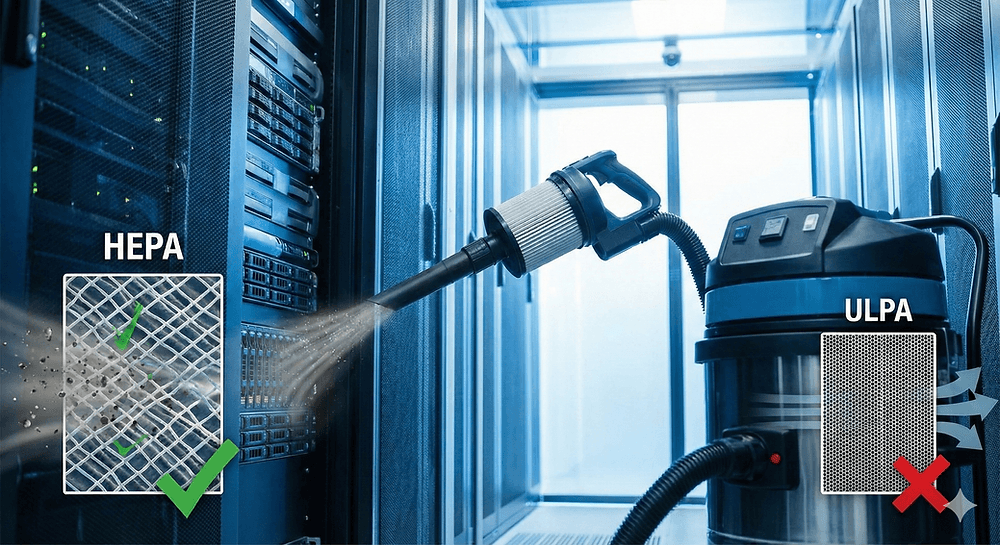
The Contenders: What is the Difference?
To understand our choice, we first need to look at what these filters actually do.
HEPA (High-Efficiency Particulate Air): The gold standard for most critical environments. A high-quality industrial HEPA filter removes 99.97% to 99.995% of airborne particles down to 0.3 microns in size.
ULPA (Ultra-Low Particulate Air): The next step up. These filters are designed to remove 99.999% of particles down to 0.12 microns.
On paper, ULPA captures smaller particles. But in the practical reality of cleaning a data hall, that "advantage" becomes a distinct performance disadvantage.
Reason 1: Airflow vs. Filtration Density
The most critical factor in vacuuming a data centre—especially the sub-floor void—is suction power (CFM or Cubic Feet per Minute).
To capture dirt, you need enough airflow to physically lift heavy contaminants like concrete dust, drywall debris, and zinc whiskers off the surface and into the machine.
The ULPA Problem: ULPA filters are incredibly dense. The mesh is so tight that it creates a massive restriction on airflow. If we were to put a ULPA filter in our industrial vacuums, the suction power would drop significantly. We might catch 0.12-micron particles, but we would lack the velocity to lift the visible dust and debris that actually threatens your hardware.
The IsoGuard Solution: HEPA filters hit the "sweet spot." They are dense enough to trap dangerous particulates (preventing them from being blown back into the room) but porous enough to allow high-velocity airflow. This ensures we can actually remove the contamination from your floor, rather than just filtering the air around it.
Reason 2: The ISO Class 8 Standard
Most data centres aim for ISO 14644-1 Class 8 compliance. This standard dictates strict limits on the number of airborne particles present in the room.
The primary threats to your servers are dust particles that clog intake fans and conductive debris (like zinc whiskers) that cause short circuits. These particles are almost exclusively within the size range that HEPA handles with ease (0.3 microns and larger).
ULPA filters are designed for ISO Class 1-3 environments, such as pharmaceutical labs or semiconductor manufacturing where even a single virus-sized particle can ruin a product. For a server room, using ULPA is like using a surgical scalpel to cut down a tree—it’s an impressive tool, but it’s the wrong one for the job.
Reason 3: No "Blowback" Guarantee
The fear some facility managers have is "blowback"—the idea that a vacuum cleaner sucks up dust and just spits fine particles out of the exhaust.
This is why IsoGuard exclusively uses Class H HEPA vacuums. The "H" stands for High Hazard. These units are sealed systems designed originally for asbestos and hazardous dust removal. When we use these in your facility, they capture 99.995% of everything they inhale. The exhaust air leaving our machines is often cleaner than the ambient air already in your server room.
Summary: The Right Tool for the Job
At IsoGuard, we don't believe in using buzzwords to upsell unnecessary specifications. We believe in precision hygiene that balances airflow with filtration. You can see all the kit and training we provide our team to deliver an impeccable service.
We choose HEPA because it allows us to remove the heavy debris threatening your uptime while ensuring the air remains safe and particulate-free.
Is your data centre due for a deep clean? Contact IsoGuard today to ensure your facility is maintained using the industry’s most effective equipment.